Choose the correct chain family before using pitch as a replacement shortcut.
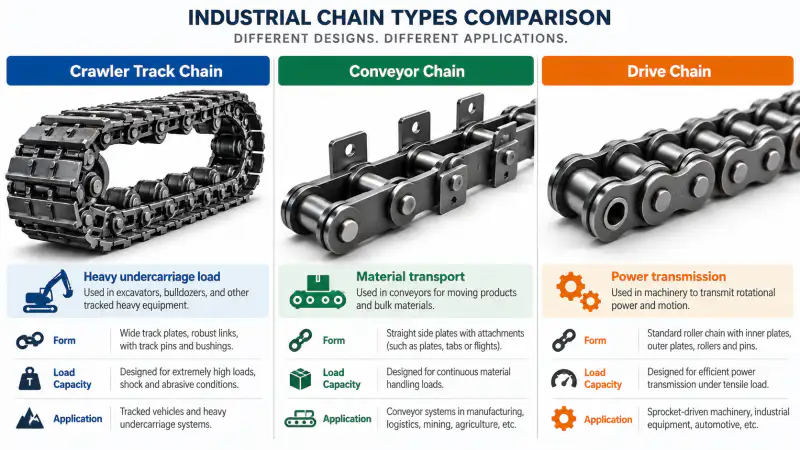
A sound replacement process starts by identifying the work the chain performs and the evidence available at the installation. The steps below are presented as a decision workflow. They do not assume that any two unmeasured components are interchangeable.
Start With The Machine Function
Ask whether the chain propels a vehicle, moves material, or transmits rotational power. This is a functional classification rather than a visual one. A bucket-wheel conveyor and a pontoon travelling track can both present heavy joints in a photograph, yet the load path is different.
Trace The Load Path
Identify which component carries ground reaction, how power reaches the chain, and where friction or support rollers work. On a track system, ground contact and guidance matter; on a conveyor, the chain may carry flights or buckets. Record this relationship with one overall photograph.
For this step, document the before-condition and the exact measurement or observation used to make the decision. If the part is already removed, show where it fitted by photographing adjacent components. Keep the photo identifier next to the measured value so it can be checked later.
Look Beyond The Links
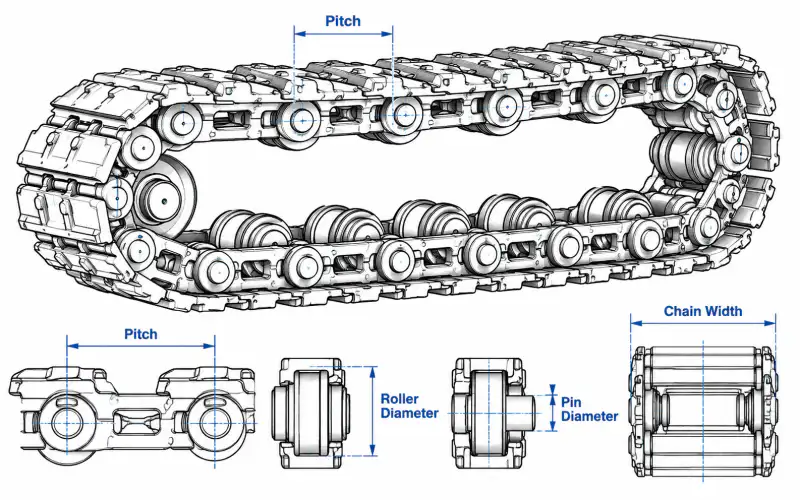
Chain plates, pins and rollers may share family resemblance across different industries. Compare attachment location, tooth engagement, travel direction and the working face. Treat naming as provisional until the assembly has been photographed in context.
A supplier reviewing look beyond the links must know whether the figure is nominal drawing data, field measurement, or an estimate from a worn component. That distinction changes what can be quoted without a sample and what needs an additional dimensional inspection.
Document The Drive
A travelling undercarriage may contain a separate power-transfer chain in addition to its track chain. A supplier therefore needs the exact location on the vehicle, not merely the phrase drive chain.
For this step, document the before-condition and the exact measurement or observation used to make the decision. If the part is already removed, show where it fitted by photographing adjacent components. Keep the photo identifier next to the measured value so it can be checked later.
Build A Replacement Record
Combine a full-machine photograph, installed chain detail, individual link dimensions and sprocket geometry. The result allows an engineer to decide whether the request concerns track, material handling, power transfer or a special assembly.
Enquiry Data Checklist
| खरीदार की प्रतिक्रिया | पुष्टि करने का कारण |
|---|---|
| Machine context | Actual chain function, installation position, equipment model if known |
| Chain dimensions | Pitch across multiple joints, width and joint reference dimensions |
| Mounting interface | Attachment locations, hole pattern and sprocket relationship |
| Service context | Working medium, abrasion exposure and wear symptoms |
| Files | Measured sketch, installed photos, part reference, quantity |
Decisions That Require Verification
Manufacturing dimensions, material grade, heat treatment, permissible operating load and any substitute part reference have to be confirmed for the real ordered configuration. General chain geometry can support preliminary identification but cannot establish a guaranteed replacement by itself.
Even when a nominal chain pitch is known, examine the mating assembly. A repair that restores one joint but leaves severely worn sprocket teeth or distorted brackets unchanged may not address the underlying fault. Distinguish immediate maintenance work from a complete system replacement decision.
Technical Review Workflow
- Identify the machine function and which component is being discussed.
- Record the measured geometry with photographs and units.
- Check the mating chain, sprocket and attachment interface.
- Define the exact replacement scope and quantity.
- Submit the sketch and photos for configuration review.
Common Questions
What if the original part number is missing?
Use installed-machine views, a measured chain sample, photographs of the connecting components and a description of the duty.
Is a matching pitch enough to place an order?
No. Joint shape, width, roller geometry, mounting offset and sprocket engagement can differ at the same nominal pitch.
Can dimensions from a worn component be used?
Yes as a provisional starting point, but significant wear must be documented and compared with an unworn reference when possible.
How can a technical enquiry be reviewed efficiently?
Supply the actual application, photos with scale, readable sketch, link count, interface details and quantity.
Trace The Power Flow
Follow the mechanism from its power source to the component that moves the machine or material. In a crawler travel system, a sprocket can circulate a chain around the undercarriage while the supported machine moves over ground. In a conveyor, chain movement advances carried material within a stationary or guided machine. A separate drive chain can transmit power to another shaft. The same heavy side plates or rollers may appear in more than one architecture. State the physical job of the chain before assigning a family name, since the name determines which measurements and questions matter next.
Look At What The Chain Supports
Photograph a complete section while installed, showing what sits above and beneath the moving links. If the link carries a cleat or flight that engages material, the item may be part of a conveying system. If the assembly carries travel shoes or bars that transmit ground reaction, a travelling undercarriage becomes more likely. These observations guide an initial classification, not a final compatibility claim. Some machine designs combine several chains in one structure. Mark each visible circuit separately on a photograph so that a replacement enquiry does not mix dimensions from different mechanisms.
Compare The Interfaces
Chain classification is more accurate when the mating parts are included. Check whether the chain engages a drive sprocket, runs against a guide or wear rail, carries an upper attachment, or wraps around an idler. Locate the chain joint centerline relative to the mounted plate or shoe. A working width that looks generous in isolation may be too narrow for a particular guide arrangement. A sketch linking the chain, attachment and support structure provides more engineering information than three disconnected close-up photographs of metal parts.
Ask The Right Buyer Questions
A buyer should state whether the objective is restoring machine travel, maintaining a conveyor flight, replacing a power-transmission link or designing a new assembly. Then supply the machine function, existing installation photo, old part drawing and quantity. If a part has been removed, indicate which face originally pointed toward the machine and which toward the working surface. Record uncertainty explicitly rather than selecting a part family just to complete a form. This gives the supplier a chance to request one more measurement instead of quoting an unsuitable chain.
Control The Vocabulary
Technical terms should be consistent through product titles, image alt text, drawings and RFQ fields. Use crawler chain for an actual crawler linkage and conveyor chain for a material conveying mechanism when the installation supports that name. Avoid publishing assumed OEM equivalence or nominal interchangeability. If a machine contains two kinds of chain, label them by position and purpose so photographs and dimensions remain attached to the correct item. Clear language reduces the risk of pairing a chain with an unrelated sprocket during procurement.
Final Identification Check
Before accepting a proposed part, request a comparison of pitch, joint configuration, width, attachment location and the mating sprocket or guide. Confirm which item has been inspected and whether the engineering record describes a new chain, a repair section or a complete assembly. The answer should also note any unverified material or surface requirement. When the available images do not support a reliable distinction, obtain a sample or drawing rather than selecting a stocked-looking part from its photograph.
Next Step
Use the measurement guides and product-family pages together. A clear enquiry record helps the technical team identify uncertainty before a replacement decision becomes expensive.