Make a replacement request measurable even when the original part number is unavailable.
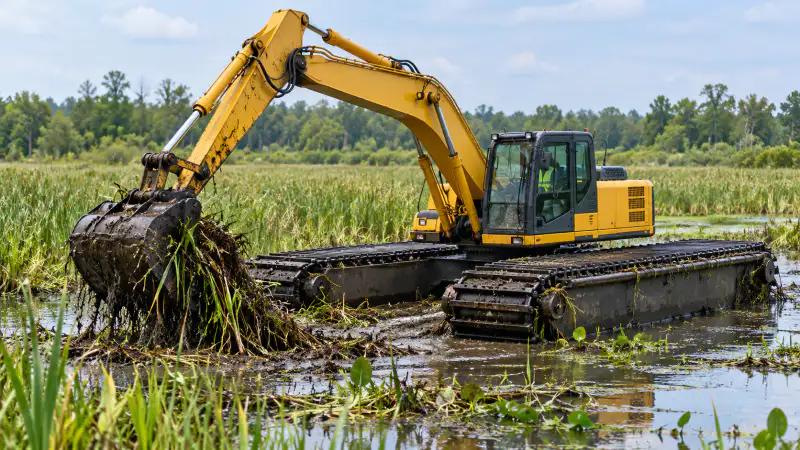
A sound replacement process starts by identifying the work the chain performs and the evidence available at the installation. The steps below are presented as a decision workflow. They do not assume that any two unmeasured components are interchangeable.
Identify The Pontoon System
Specify whether the machine uses floatation pontoons, a conventional crawler undercarriage or a special conversion. The same excavator upper structure can be mounted on very different travel systems.
State The Travel Environment
Mud, silt, abrasive sand, submerged operation, occasional salt water and debris loads create different maintenance conditions. Describe actual use instead of assuming all marsh sites are identical.
For this step, document the before-condition and the exact measurement or observation used to make the decision. If the part is already removed, show where it fitted by photographing adjacent components. Keep the photo identifier next to the measured value so it can be checked later.
Provide Chain Data
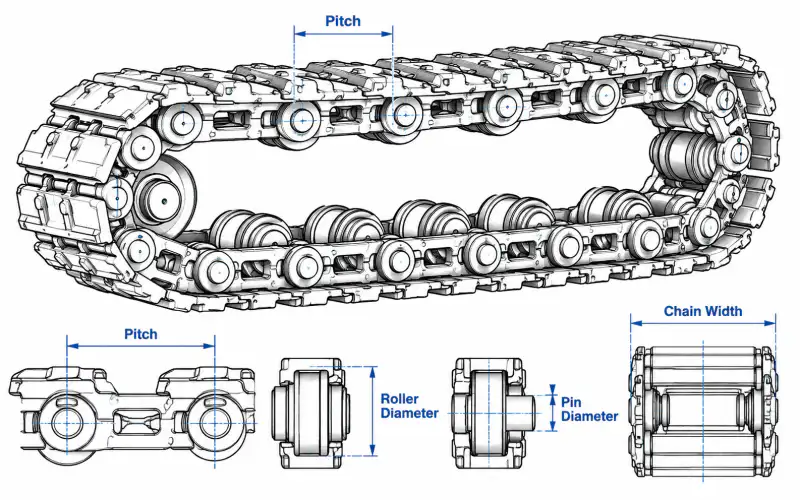
At minimum send pitch, link count, approximate overall width, attachment layout and sprocket photos. Add an original drawing or sample reference whenever possible.
A supplier reviewing provide chain data must know whether the figure is nominal drawing data, field measurement, or an estimate from a worn component. That distinction changes what can be quoted without a sample and what needs an additional dimensional inspection.
Describe Replacement Scope
Indicate whether one strand, a complete matched pair or only individual links and pins are required. Identify the machine side to prevent quoting one hand when the other is needed.
For this step, document the before-condition and the exact measurement or observation used to make the decision. If the part is already removed, show where it fitted by photographing adjacent components. Keep the photo identifier next to the measured value so it can be checked later.
Review The Quotation
Ask the supplier to identify assumptions about material, interface, tolerances, surface protection and manufacturing lead time. A quote based only on photographs should be labelled provisional.
Enquiry Data Checklist
| Opinión del comprador | Motivo para confirmar |
|---|---|
| Machine context | Actual chain function, installation position, equipment model if known |
| Chain dimensions | Pitch across multiple joints, width and joint reference dimensions |
| Mounting interface | Attachment locations, hole pattern and sprocket relationship |
| Service context | Working medium, abrasion exposure and wear symptoms |
| Files | Measured sketch, installed photos, part reference, quantity |
Decisions That Require Verification
Manufacturing dimensions, material grade, heat treatment, permissible operating load and any substitute part reference have to be confirmed for the real ordered configuration. General chain geometry can support preliminary identification but cannot establish a guaranteed replacement by itself.
Even when a nominal chain pitch is known, examine the mating assembly. A repair that restores one joint but leaves severely worn sprocket teeth or distorted brackets unchanged may not address the underlying fault. Distinguish immediate maintenance work from a complete system replacement decision.
Technical Review Workflow
- Identify the machine function and which component is being discussed.
- Record the measured geometry with photographs and units.
- Check the mating chain, sprocket and attachment interface.
- Define the exact replacement scope and quantity.
- Submit the sketch and photos for configuration review.
Common Questions
What if the original part number is missing?
Use installed-machine views, a measured chain sample, photographs of the connecting components and a description of the duty.
Is a matching pitch enough to place an order?
No. Joint shape, width, roller geometry, mounting offset and sprocket engagement can differ at the same nominal pitch.
Can dimensions from a worn component be used?
Yes as a provisional starting point, but significant wear must be documented and compared with an unworn reference when possible.
How can a technical enquiry be reviewed efficiently?
Supply the actual application, photos with scale, readable sketch, link count, interface details and quantity.
Describe The Actual Machine
Begin with the equipment function and configuration rather than a generic request for marsh chain. Indicate whether the machine uses pontoons, a conventional crawler frame or another adapted travelling system. Show the track circuit in relation to the floating structure and the drive components. If two parallel chains carry a wide assembly of bars or shoes, record both the cross-track spacing and the individual link geometry. The upper structure model alone may not identify the undercarriage after field modifications. A photograph and simple layout sketch often answer more questions than a brand name.
Provide Chain Measurements
Send pitch measured over several joints, link count, approximate length, working width, pin or roller dimensions and attachment locations. Mark the dimensions on an image so the technical reviewer knows exactly what surfaces were used. On heavily worn equipment, indicate which readings are condition measurements rather than nominal specifications. Include the required unit system and identify whether the part is left-side, right-side or symmetric. If some areas are inaccessible without major disassembly, say so and offer the available original drawing or a loose sample for additional review.
Capture Mating Components
The drive sprocket, idler, guides, mounting bars and support surfaces influence whether a replacement chain can run reliably. Photograph the chain entering and leaving the sprocket, with another side view showing hub offset and nearby clearances. Note visible sprocket tooth wear and any modified mounting hardware. If the requested part is an individual attachment, show its location along a straight and curved portion of the chain circuit where possible. These images reduce the likelihood that an item with correct standalone dimensions will fail at the assembled interface.
State The Travel Environment
Explain whether the track operates in fresh water, muddy sediment, abrasive sand or periodic dry ground, and how long it remains immersed during typical duty. Provide observable conditions rather than a generic severe-service label. If tracks become packed with debris or difficult to tension after shutdown, report that maintenance history. The manufacturer can then identify which design questions deserve attention and which data require further testing. None of these service descriptions alone proves that a particular coating, material or performance rating will be suitable.
Define The Procurement Scope
A purchasing request should state complete chains, short sections, links, plates, pins or a matched chain-and-sprocket package. Clarify quantity per machine and total number of machines in the enquiry. Include the destination country, requested document format and whether sampling or drawing approval is needed before bulk production. If the project schedule has a fixed site shutdown, provide the date as context without treating a general reference lead time as a guaranteed shipment date. Supply a contact email that is actually monitored for engineering questions.
Review The Quotation Assumptions
Before accepting the offer, ask which measurements were verified, which were supplied only as field estimates and which require sample approval. Confirm whether the quote includes joining hardware and all mating parts needed for installation. Material and heat-treatment claims should appear only where supported by the agreed specification. Clarify how dimensional acceptance will be documented and whether any changes are allowed after drawing approval. A useful quote highlights missing compatibility evidence rather than masking it behind a familiar-looking product photograph.
Next Step
Use the measurement guides and product-family pages together. A clear enquiry record helps the technical team identify uncertainty before a replacement decision becomes expensive.