
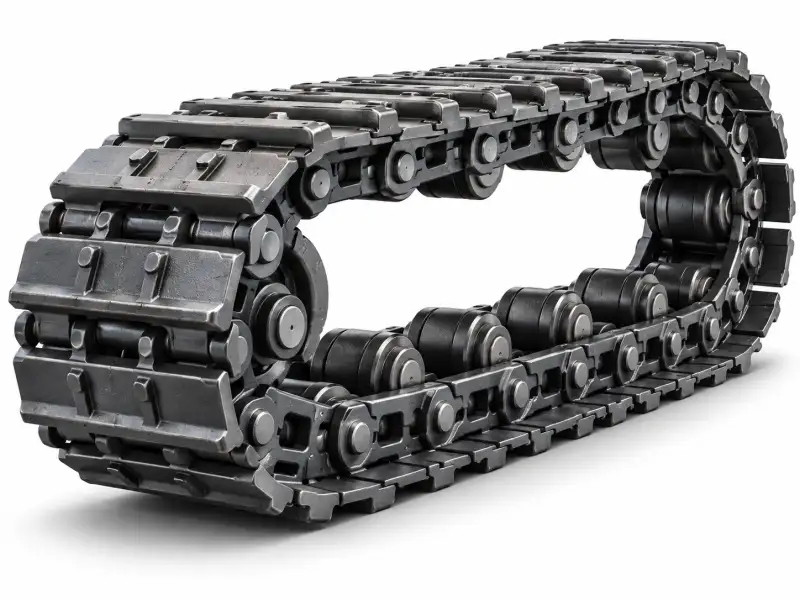
Description
Complete chain assembly enquiry for an amphibious pontoon or marsh travel system. Match the existing link geometry and attachment layout before selecting a replacement.
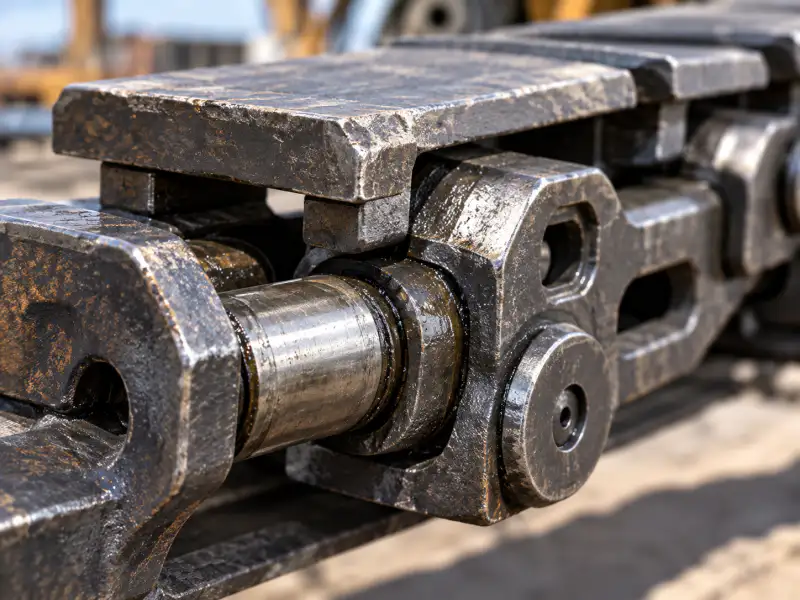
Product Role
The marsh buggy track chain assembly is evaluated by the real mechanical job it performs: carrying and guiding the repeating track structure along the machine undercarriage. The key specification work concerns complete strand geometry, mounting provisions and compatible running path. Clear identification comes before any claim of machine interchangeability.
An engineering enquiry should distinguish the assembled part from the components around it. Differences in pin fits, spacing, attachment position and running clearance can be decisive even when two photographs show broadly similar metal profiles. Describe how the installed part moves and where it transfers force.
Construction And Interfaces
The neighbouring mechanical interfaces to review are track plate or cleat mounts, rollers, the idler path and the matching drive sprocket. These relationships should be documented by a drawing or an installed-machine photograph wherever possible. A free-standing image may omit the very faces that control assembly fit.
Record the orientation, working face, mounting fasteners, end retention and any direction-dependent geometry. Where the original assembly has been modified in the field, identify the modifications before asking for a nominal replacement. The current mechanical envelope, not only the original label, should guide the review.
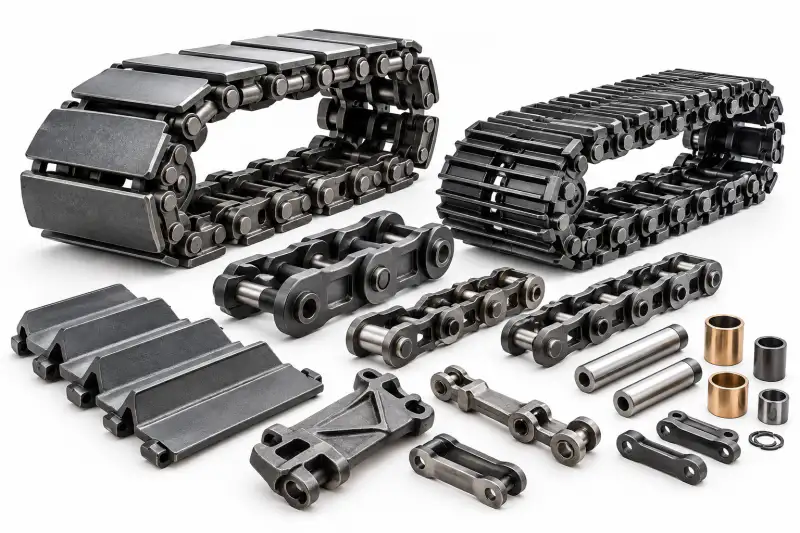
Key Selection Variables
| Variable to identify | Verification requirement |
|---|---|
| Complete chain length and link count | Confirm using part drawing, measurement or the actual equipment installation |
| Pontoon or crawler frame orientation | Confirm using part drawing, measurement or the actual equipment installation |
| Drive and idler sprocket relationship | Confirm using part drawing, measurement or the actual equipment installation |
| Cleat or shoe mounting hole positions | Confirm using part drawing, measurement or the actual equipment installation |
| Corrosion, mud and abrasion exposure | Confirm using part drawing, measurement or the actual equipment installation |
Operating Conditions
Pontoon travel systems and purpose-built marsh equipment require careful distinction from standard ground-crawler chains. The chain has to align with the operating envelope, contact surfaces and drive elements for the specific machine.
Specify water, soil or debris exposure, operation cycle, lubrication access and the reason for replacement. Severe grit and difficult maintenance access often make joint protection and inspection planning particularly important, although the acceptable material and treatment must still be agreed for the ordered design.
Geometry Before Model Numbers
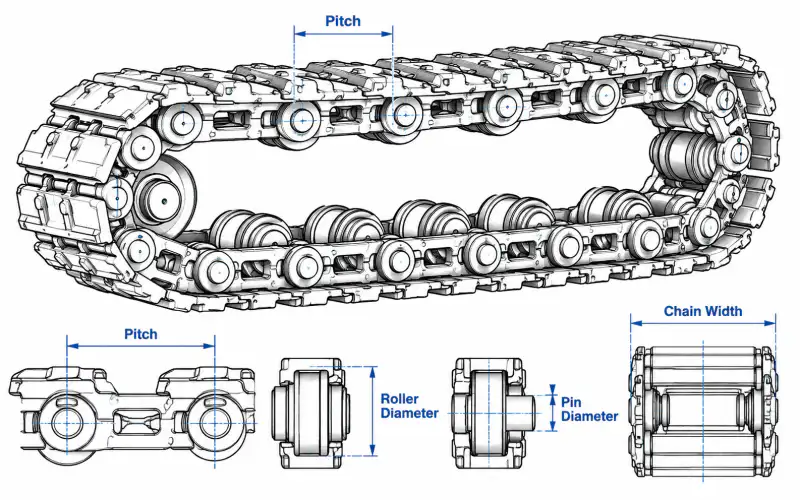
The useful first measurements are usually joint centre spacing, cross-sectional clearance and the contact surface that mates with the next component. If a worn part is the only reference, take measurements at several positions and disclose wear or deformation. A dimensional outline drawing is preferable to guessing a model number from a picture.
Measure the assembled installation wherever safe and practical. A separated link or attachment may lose its orientation once removed. Record adjacent components in the same photograph to establish the correct chain side and installation direction.
Integration And Installation
Confirm these parts before installation: track plate or cleat mounts, rollers, the idler path and the matching drive sprocket. Compare the overall running width, clearance to guards and frames, and the required joining or fastening procedure. A chain assembly that moves freely by hand may still contact a nearby part during a fully loaded travel cycle.
Installation instructions and tightening values must come from the approved machine and component drawings. Do not reuse a generic chain torque or fit specification unless the design and fastener class are confirmed. If the existing sprocket shows heavy hooking or wear, review it together with the new chain components.
Inspection And Wear
The main engineering risk is that an apparently similar industrial chain can have a different link profile, attachment pitch or running envelope. Observe joint play, uneven wear, changes in surface contact and any deformation around mounting areas. Compare both sides or repeated links where feasible rather than relying on a single damaged component.
For a serviceable inspection record, show the position on the machine, measured condition and a photo with scale. Record which dimensions are affected by wear and which features remain good reference surfaces. A field photo does not establish material properties or load ratings.
Replacement Measurements
Suggested data collection: check chain pitch at several links; confirm strand count and track width; photograph both sides and the drive/idler zones. Add the total quantity, any urgent maintenance date and the country of destination. Mark if the request is for a complete chain strand, an individual link, a matched pair or repair hardware.
Drawing-Based Options
Possible engineering work can involve adapting geometry to a verified sample or creating a matched replacement set. Feasibility is reviewed against actual drawings, material requirements, measurement access and available inspection evidence. No unconfirmed alloy grade, maximum load or delivery promise is assigned to this generic product class.
If compatibility remains uncertain, request a small validation stage before a larger production order. That may include one physical sample, a full joint drawing or a controlled measurement review. The aim is to make fit assumptions visible before the parts are ordered.
Pontoon Travel Interface
A floating undercarriage changes the way a track circuit is supported and inspected. Begin with an elevation of the pontoon and identify whether the chain is attached directly to transverse bars, a continuous shoe arrangement or another mounting structure. The drive sprocket center, front turning radius, lower return path and guide clearances need to be located relative to that arrangement. A replacement request should show the machine both on level ground and in the configuration normally used for travel. Do not infer that a land-crawler chain will fit from visual similarity alone. Look at the interface actually carrying each track bar, not only the chain side plate.
Matched Circuit Review
Replacement of one portion of a long track circuit should start with the condition of the remaining strand. Compare pitch readings over several joints at the upper and lower runs, then examine the existing sprocket teeth for uneven contact. On machines with two parallel chains supporting a common set of track bars, each strand must be considered together with its mounting spacing and bar pitch. Misalignment between strands can twist attachments and create a false impression that the replacement chain itself is defective. Identify whether the quote covers a complete circuit, both circuits or a short repair section, and record any different hardware supplied with the original machine.
Wetland Service Record
When the equipment works in silty water, installation access and cleaning procedure are as important to describe as the nominal chain dimensions. A field report should state whether the track usually operates submerged, cycles between wet and dry areas or experiences abrasive sand while turning. Record where packed sediment accumulates, whether guards make inspection difficult and whether link movement becomes stiff after storage. These observations do not establish a particular alloy or surface treatment, but they give the engineering reviewer a clearer basis for discussing corrosion protection, replacement scope and service inspection intervals. Photos of the same location before and after cleaning can be especially useful.
Technical Enquiry Checklist
- Complete chain length and link count
- Pontoon or crawler frame orientation
- Drive and idler sprocket relationship
- Cleat or shoe mounting hole positions
- Corrosion, mud and abrasion exposure
- Photos of installed mating parts
- Available drawing or sample reference
- Quantity, delivery destination and requested documentation
Frequently Asked Questions
How should a complete chain be measured before replacement?
Record nominal drawing values separately from field dimensions and clearly indicate wear. Confirm pin or roller geometry, pitch and mounting layout wherever relevant.
Can a new chain work with the existing drive sprocket?
Check chain pitch, roller geometry, tooth form, side clearance and the hub position as one assembly. A similar visible tooth count does not prove suitability.
Which photos identify the attachment interface?
Provide a front, side, end and installed view with a physical scale. Photos should show the relationship to the mating components rather than only a clean isolated part.
When is a sample link better than nominal pitch alone?
This depends on the actual mating parts, wear condition and operating role. A drawing or existing sample should be reviewed before deciding on repair or replacement.
Request A Configuration Review
Share photos, measured chain geometry and an equipment drawing to confirm whether this component class is appropriate. Provisional illustrations are not a substitute for a final itemized quotation.